Architecture
From input to features
I-JEPA, used for real images
Click the picture to open it full size.
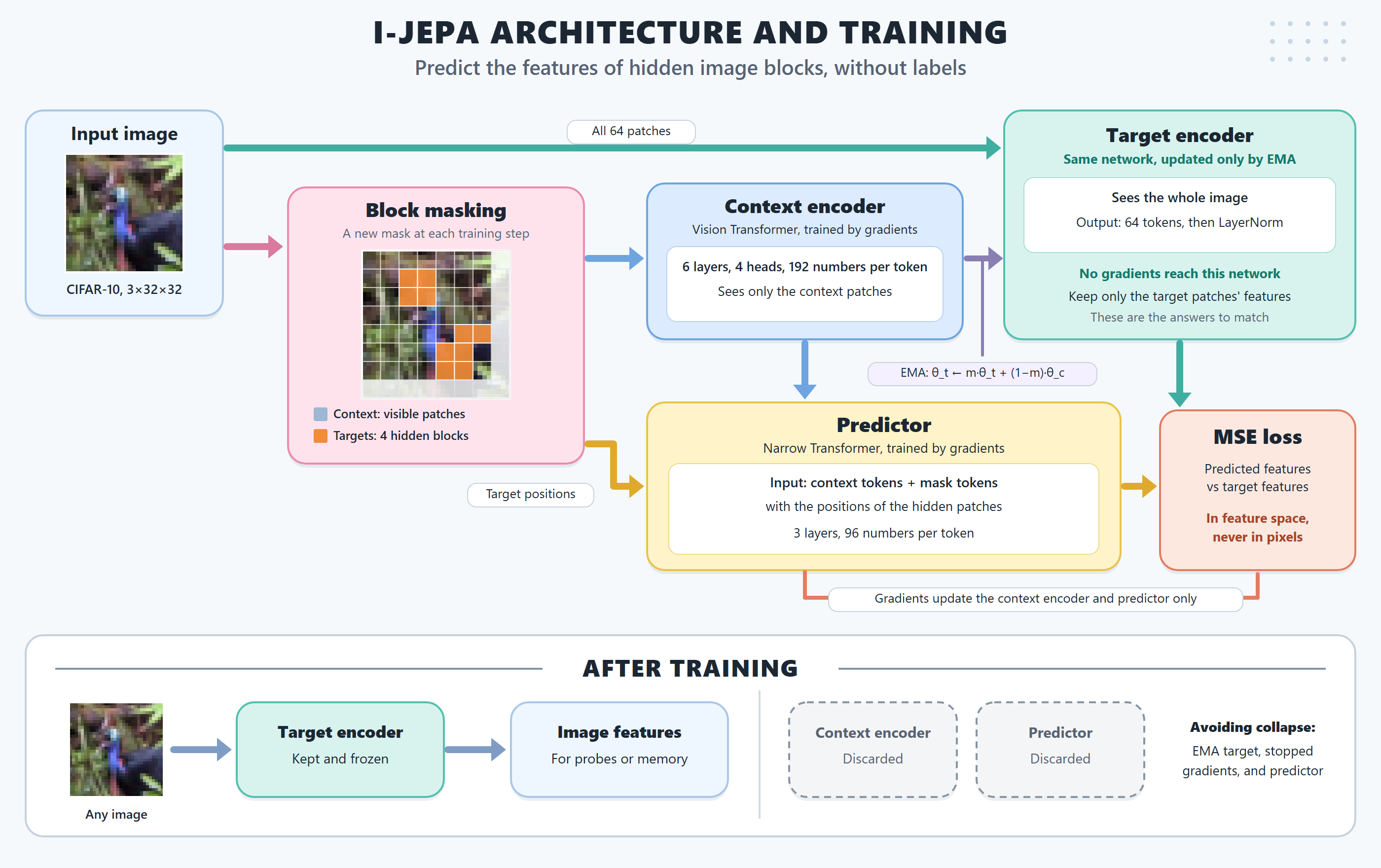
Layers of this model
A small version made for 32×32 images. The original I-JEPA paper uses much larger Vision Transformers.
| Part | Operation | Output | Trained by |
|---|---|---|---|
| Patches | 4×4 pixels, 3×32×32 input, linear embedding | 64 tokens × 192 | Gradients |
| Positions | One learned vector per patch | 64 tokens × 192 | Gradients |
| Context encoder | 6 Transformer layers, 4 heads, on visible tokens only | Visible tokens × 192 | Gradients |
| Target encoder | Same network, on all tokens, then LayerNorm | 64 tokens × 192 | EMA, 0.996 rising to 1 |
| Predictor | Projects to 96, 3 Transformer layers, 4 heads, projects back | Target tokens × 192 | Gradients |
| Loss | MSE, predicted vs target features | One number | — |
| Image feature | Mean of the target encoder's tokens | 192 numbers | Used after training |
The smallest JEPA (Lesson 1)
The same idea, with no images or attention, so each part is easy to see.